Willy Wonka and the "Heaven" Factory
Introduction
What does heaven look like? What does heaven smell like? What does heaven taste like? Well according to the movie Willy Wonka and the Chocolate Factory, heaven is edible. The 1971 movie was based on the book Charlie and the Chocolate Factory, a children's novel by British author Roald Dahl. According to the author, he based his novel on stories he had heard when he was a child about candy spies who would take jobs at competitors' factories in order to steal their secret recipes. Although there is an innocent topical plot of candy I believe there is something hidden deep down inside this candy covered nugget, a metaphor for life, love, and the pursuit of heaven.
Description and Context
Charlie Bucket is a poor and humble child who is forced to help out his widowed mother take care of his two sets of bed stricken grandparents. His mother works hard doing laundry, while Charlie is forced to take on a newspaper job to help.While the other children run after school to the candy shoppe, Charlie is forced to watch from the outside at all the happiness that candy is bringing the other children.
Charlie had started to lose hope, that was until he heard about Willy Wonka’s wonderful contest. Five lucky winners were going to win the chance of a lifetime, a visit to the Wonka Factory. Why was this so significant? Because Willy Wonka was an isolated candy maker that was forced to shut down his factory due to spies. All of the chocolate makers were sending spies disguised as workers to steal all of the secret recipes. The contest selection process included five golden tickets hidden inside chocolate bar wrappers.
One of the dirty spies was a competitor by the name of Arthur Slugworth. Now that Wonka had started his factory up again, Slugworth will stop at nothing to get his hands on Wonka’s newest creation, the everlasting gobstopper.

The first to find a ticket is Augustus Gloop, a large German boy with an unending appetite. The second ticket finder is a rich and spoiled girl named Veruca Salt. The next ends up in the hands of Violet Beauregarde, a gum chewing addict. The fourth ends up in the hands of Mike Teevee who has spent the most part of his life watching television. Through the entire movie Mr. Slugworth happens to appear at every location a golden ticket is found.
Charlie happens upon some money lost in the gutter outside of the candy shoppe. He decides to go in and indulge on the spoils within. After finding out that the fifth ticket finder is a fake, he quickly opens the chocolate bar in his hand to quickly discover he has indeed found the fifth and final golden ticket. Once Grandpa Joe hears the news he leaps from the bed that he’s been in for 20 years in order to accompany Charlie to the factory.
The day finally comes when Charlie and the rest of the winners get to enter the mysterious Chocolate Factory. The factory is filled with the most wildly imaginable rooms and people. The factory workers are little people called Oompa Loompas. There are rooms filled with tasty wallpaper, edible plants, and a chocolate river. While moving from room to room on a tour of the factory each of the children are disqualified for acting out their horrible qualities. Charlie even disqualifies himself by sneaking some fizzy lifting drinks while in the factory.
After finding out he is disqualified, Grandpa Joe goes on the rampage. After the argument that ensues Charlie proves he is worthy of the prize by giving back the everlasting gobstopper showing his penitence and trust. Wonka reveals that Charlie is the winner and is given the factory as the grand prize after which Charlie gets to see the whole factory through a flying glass elevator.
Method of Analysis
Given all the hidden meanings and subjects in the film, I am convinced that the best analysis of this artifact is to use the tenants for analyzing metaphors. My first step was to view the entire film again, one more of the many times since childhood. The film is full of metaphors and so I had to isolate certain metaphors in the film. There are very obvious metaphors that are prominent in this artifact. The most prominent are the negative characters of each of the ticket winners.I believe that the artifact’s metaphors and underlying theme has a deeper effect on the audience. There are several patterns that suggest that the entire story is based on a Christian point of view of Jesus and Heaven.
I will look at Max Black’s beginning of his theory of analyzing metaphors. The first is that a metaphor consists of two topics, a primary and a secondary one. I will discuss in the next section the patterns that suggest this same idea.
Artifact Analysis
In watching the movie I believe there are three major metaphors that suggest the movie is dealing with the Christian view of Heaven, Hell, and the Devil.The first tenor is the idea of heaven and the vehicle used to express that idea is the Chocolate Factory.

The Chocolate Factory is mysterious, just like heaven and the afterlife. The entire world is mesmerized by this secret and locked down place. Just the idea of how to get into the factory produces mass hysteria. The entire world tries different ways of finding their golden ticket into the factory (all of which are metaphors).
The people in the world have all caught a glimpse of this heaven by tasting the wonderful chocolate it produces. They have all felt and partaken of its paradise. The spoils of this place are sung in the words of the song that Mr. Wonka sings in the factory, “if you want to view paradise simply look around and view it, anything you want to, do it.” People will do anything to get into the factory, even try and create a fake ticket.
The factory has been locked up to outsiders. As Charlie stands staring at the factory a mysterious man states, “Nobody ever goes in….nobody ever goes out.” This idea parallels the idea of heaven. The world is astounded at the thought of getting a glimpse of this magical place.
The idea of getting into the factory brings Grandpa Joe back to his feet after 20 years of bed rest. Talk about a miracle! Forget the atrophied legs and muscles it’s time to go to the big house as he sings, “I never dreamed that I would climb over the moon in ecstasy, but nevertheless it’s there that I’m shortly about to be!” What else could create such a miracle? Heaven?
The second tenor the Christian idea of Jesus and the delivery of that vehicle is through Willy Wonka

Willy Wonka has not been seen but his presence is everywhere (found in his chocolate). This is similar to the Christian idea of Jesus and his presence throughout the world and his influence on the world. Just like Wonka holds the key to the factory, Jesus is the key to heaven. Throughout the factory they go through different types of doors and vehicles and Willy is the only one who knows the combinations.
Even the way that Wonka speaks in poetry and vague metaphors is similar to Jesus teaching in parables. He is constantly speaking in different languages as well as using several literary quotes.
Without the help of Willy Wonka the other children find their demise in several horrible ways. Even though prompted and encouraged by the factory leader, the children continue to demonstrate their sins. Their downfalls are represented in several ways including turning into a blueberry and a fiery death in a furnace.
In the end Mr. Wonka gives up everything for this humble and penitent boy to take over the factory. The boy has been tested and tempted and overcame all.
Now Charlie gets to ride around in a glass elevator which can take him anywhere in the world at the touch of a button. To me the glass elevator doesn't make sense in the real world. Willie Wonka had the power to leave the Chocolate Factory at any time. Who knows if he did or not. But he has the same power that Jesus has to be anywhere he wants to be. I'll bet Jesus' model is an upgrade and is a little more invisible.
Now Charlie gets to ride around in a glass elevator which can take him anywhere in the world at the touch of a button. To me the glass elevator doesn't make sense in the real world. Willie Wonka had the power to leave the Chocolate Factory at any time. Who knows if he did or not. But he has the same power that Jesus has to be anywhere he wants to be. I'll bet Jesus' model is an upgrade and is a little more invisible.
The final tenor is the idea of Satan and/or temptation through the vehicle of Mr. Slugworth.

Mr. Slugworth is presented as a competitor. Whenever a golden ticket is found Slugworth is there somehow. He starts whispering in each of the young children’s ear. This is similar to the Christian idea of Satan. Satan is always there to tempt and lead people astray from heaven. Mr. Slugworth is up to much the same work. He tries to bribe each of the children and test them. If they pass the test they are given the ultimate prize, the Chocolate Factory.
Each one of the ticket holders finds themselves tempted by Mr. Slugworth. Charlie is cornered on the way home and told that he would be given money in return for the Wonka Everlasting Gobbstopper.
Even in the end we find that Mr. Slugworth was all part of the plan. He was all part of the grand scheme or test. From the beginning Wonka had planned this test and Mr. Slugworth's role in this test. Just like Christianities view of Satan and his role in the plan of salvation.
Even in the end we find that Mr. Slugworth was all part of the plan. He was all part of the grand scheme or test. From the beginning Wonka had planned this test and Mr. Slugworth's role in this test. Just like Christianities view of Satan and his role in the plan of salvation.
Contribution
Willy Wonka and the Chocolate Factory is a child’s story that is too scary for children. It has deep rooted messages about bad habits or “sins” that keep you from reaching the Chocolate Factory or “heaven.” The film has been seen by millions of people and has recently sparked a remake in 2005, Charlie and the Chocolate Factory.
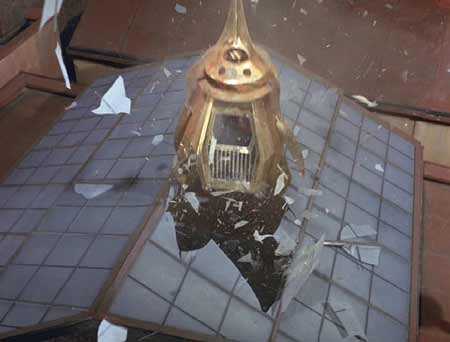
The entire film is about a test. Christians believe that this life is about overcoming temptation and is a test. If we can avoid the sins (displayed by all the unruly children and their 'deadly sins') we can pass the test and through repentance (Everlasting Gobbstopper) and forgiveness from Jesus (Mr. Wonka) inherit heaven (The Chocolate Factory) and become immortal (glass elevator). And get to travel anywhere in the world in our Glass Elevator!
The entire film is about a test. Christians believe that this life is about overcoming temptation and is a test. If we can avoid the sins (displayed by all the unruly children and their 'deadly sins') we can pass the test and through repentance (Everlasting Gobbstopper) and forgiveness from Jesus (Mr. Wonka) inherit heaven (The Chocolate Factory) and become immortal (glass elevator). And get to travel anywhere in the world in our Glass Elevator!
Many who watch the film instantly catch the message of unruly and pretentious children and the damage that can be done if they are allowed to rule their parents. However, there are only a few that make the same connection to the Christian message of heaven, hell, and the devil.


